What if I told you that a content management system, written in a language many declared “dead,” just completed one of the most ambitious transformations in open-source history?
This isn’t a story about survival. It’s a story about reinvention. About a community that looked at a 15-year-old codebase and said: “We can make this better. We can make this modern. We can make this last another 15 years.”
This is the story of Drupal.
Why Should You Care?
Before we dive into version numbers and release dates, let me ask you something:
Have you ever inherited a legacy system that made you want to quit programming entirely?
Yeah. Me too.
But here’s what’s fascinating about Drupal: while other legacy systems crumbled under technical debt, Drupal’s community made the audacious decision to completely rewrite their codebase not once, but twice in a single decade.
The result? A CMS that powers 2% of all websites globally, including:
- The White House
- Tesla
- The Economist
- NASA
- Harvard University
If you’re an enterprise developer, a PHP engineer questioning your career choices, or someone curious about how massive open-source projects evolve — this story is for you.
Let’s begin.
Part I: The Golden Era of Drupal 7 (2011-2015)
The Beloved Monolith
Release Date: January 5, 2011
Drupal 7 was, in many ways, the peak of “classic” Drupal. It represented everything the community loved about the CMS — and everything that would eventually need to change.
Picture this: It’s 2011. jQuery is king. Responsive design is just becoming a thing. And PHP developers are building everything with procedural code and hook-based architectures.
Drupal 7 was perfect for this era.
What Made D7 Special
The hook system was Drupal’s secret sauce. Want to modify how a node is displayed? Implement hook_node_view(). Need to alter a form? There’s hook_form_alter(). It was elegant in its simplicity:
/**
 * Implements hook_node_view().
 */
function mymodule_node_view($node, $view_mode, $langcode) {
  if ($node->type == 'article') {
    $node->content['my_addition'] = array(
      '#markup' => '<p>Custom content here!</p>',
      '#weight' => 10,
    );
  }
}
The Psychology of Familiarity: There’s a reason developers loved D7. It followed patterns they already knew. Functions. Arrays. Simple includes. No need to understand dependency injection or service containers. Just write your function, clear the cache, and watch it work.
The Numbers That Mattered
| Metric | Drupal 7 |
|---|---|
| Core Modules | 75 |
| Lines of Code | ~1.2 million |
| Minimum PHP | 5.2.4 |
| Database Support | MySQL, PostgreSQL, SQLite |
| Release Cycle | ~2-3 years |
The Cracks Begin to Show
But by 2013, the cracks were visible to those who looked closely:
-
Performance Issues: The bootstrap process was heavy. Every page load required dozens of database queries.
-
No Modern PHP: While the PHP community embraced Composer, namespaces, and PSR standards, Drupal remained stubbornly procedural.
-
The “Not Invented Here” Syndrome: Drupal had its own form API, its own caching system, its own everything. Integration with external libraries was painful.
-
Mobile Was an Afterthought: In a world going mobile-first, Drupal 7’s admin interface required a desktop.
The Uncomfortable Truth: Drupal 7 was showing its age. And the community knew something radical had to happen.
Part II: The Great Refactoring — Drupal 8 (2015-2020)
The Decision That Changed Everything
In 2011, something unprecedented happened in Drupal’s history.
Dries Buytaert, Drupal’s creator and benevolent dictator, made an announcement that sent shockwaves through the community:
“Drupal 8 will be built on Symfony components.”
Wait. What?
Drupal — the CMS famous for doing everything its own way — was going to adopt someone else’s code?
This wasn’t just a technical decision. It was a philosophical revolution.
The Psychology of Change Resistance
Let me paint you a picture of the community reaction:
The Optimists: “Finally! Modern PHP! Dependency injection! Unit testing!”
The Skeptics: “This will alienate our entire developer base. Everyone will have to relearn Drupal.”
The Pragmatists: “Can we afford NOT to change? Look at Laravel. Look at Symfony. We’re falling behind.”
Sound familiar? This is the same debate that happens in every organization facing modernization. And Drupal chose the hard path.
What Actually Changed in D8
The transformation was staggering. Here’s a before/after comparison:
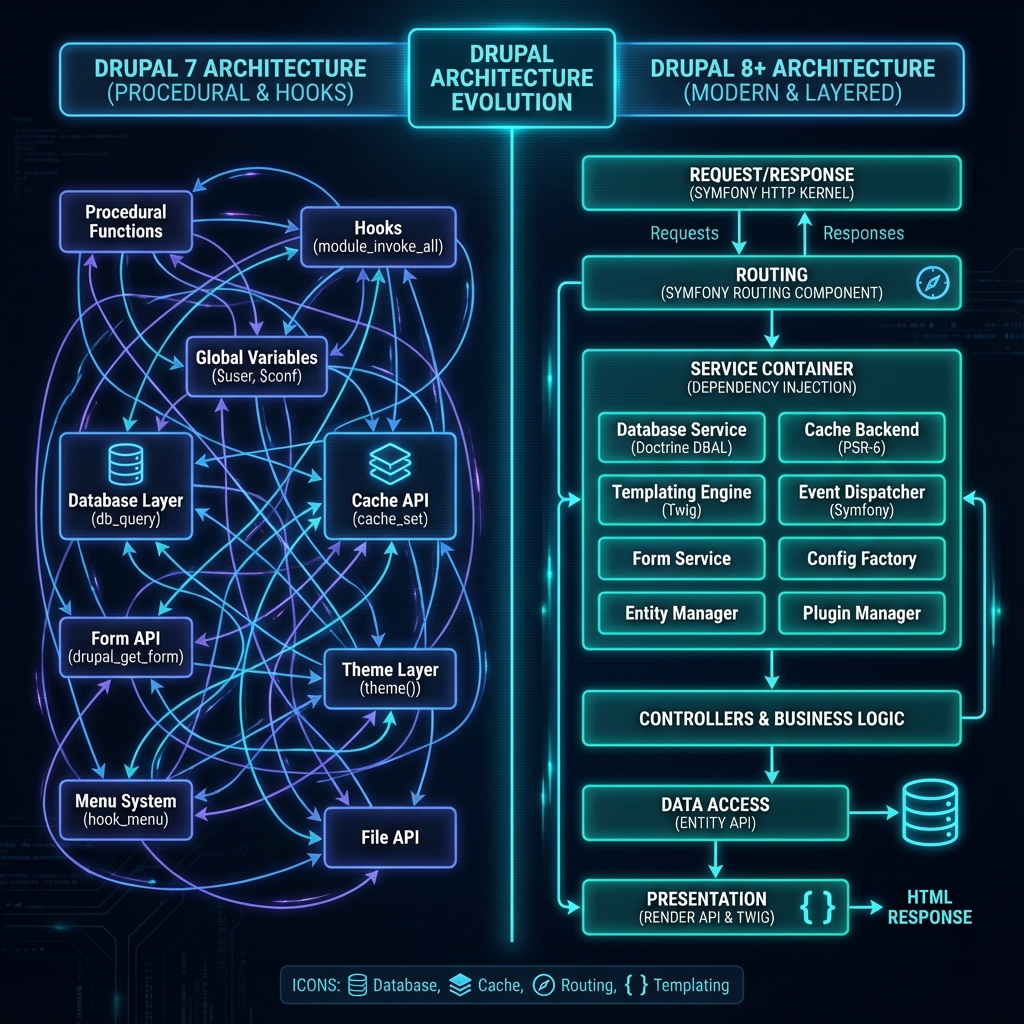
Architecture Comparison
| Aspect | Drupal 7 | Drupal 8 |
|---|---|---|
| PHP Style | Procedural | Object-Oriented |
| Dependency Management | None | Composer |
| Templating | PHPTemplate | Twig |
| Routing | hook_menu | Symfony Routing |
| Services | Global $conf | Dependency Injection |
| Configuration | Database | YAML Files |
| Caching | Custom | Symfony + Custom |
| Testing | SimpleTest | PHPUnit |
Let’s look at what this meant in practice:
Before (Drupal 7):
/**
 * Implements hook_menu().
 */
function mymodule_menu() {
  $items['my-page'] = array(
    'title' => 'My Page',
    'page callback' => 'mymodule_page_callback',
    'access callback' => TRUE,
  );
  return $items;
}

function mymodule_page_callback() {
  return 'Hello, World!';
}
After (Drupal 8):
// mymodule.routing.yml
mymodule.my_page:
  path: '/my-page'
  defaults:
    _controller: '\Drupal\mymodule\Controller\MyController::content'
    _title: 'My Page'
  requirements:
    _access: 'TRUE'
// src/Controller/MyController.php
namespace Drupal\mymodule\Controller;
use Drupal\Core\Controller\ControllerBase;
class MyController extends ControllerBase {
public function content() {
return [
'#markup' => 'Hello, World!',
];
}
}More files? Yes. But also:
- Unit testable controllers
- Clear separation of concerns
- IDE autocomplete support
- Industry-standard patterns
The Hidden Gems of Drupal 8
Beyond the architectural changes, D8 introduced features that made enterprise developers weep with joy:
1. Configuration Management
No more “database diff” nightmares. Configuration lived in YAML files that could be version controlled:
# config/sync/system.site.yml
name: 'My Awesome Site'
mail: admin@example.com
slogan: 'Built with Drupal 8'
page:
  front: /node
  403: ''
  404: ''
2. Built-in Web Services
REST and JSON:API support out of the box. Headless Drupal became a first-class citizen:
curl https://example.com/jsonapi/node/article3. BigPipe
Facebook’s rendering strategy, built into core. Pages that felt instant even when they weren’t.
4. Multilingual Everything
Eight separate modules in D7 became one unified system. Translation was no longer an afterthought.
The Cost of Progress
But let’s be honest about the downsides:
Learning Curve: Developers who knew D7 inside-out suddenly felt like beginners. OOP, services, plugins, annotations — it was overwhelming.
Performance Concerns: Early D8 releases were slower than D7 for simple sites. More abstraction meant more overhead.
Module Ecosystem Lag: The contrib ecosystem took years to catch up. Major modules like Panels, Display Suite, and Organic Groups needed complete rewrites.
The D8 Release Timeline:
- Development started: 2011
- First beta: October 2014
- Stable release: November 2015
- 4.5 years of development
The longest development cycle in Drupal history. But it was worth it.
Part III: The Cleanup — Drupal 9 (2020-2022)
The Smartest “Major Release” Ever
Here’s where Drupal did something genuinely clever.
Traditional major version upgrades are painful. Ask anyone who migrated from Python 2 to 3, or from Angular 1 to 2. Major versions typically mean rewriting everything.
But Drupal 9? It was designed to be easy.
Release Date: June 3, 2020 (exactly on schedule, despite a global pandemic)
The Deprecation Strategy
Drupal 8’s later releases (8.8, 8.9) included deprecation warnings for every API that would be removed in D9. This meant:
- Run your code through the Upgrade Status module
- Fix all deprecated function calls
- Update your dependencies
- Done. Welcome to Drupal 9.
No rewrite. No migration. Just cleanup.
// Deprecation notice in D8.8+
@trigger_error('drupal_set_message() is deprecated. Use messenger service instead.', E_USER_DEPRECATED);

// The new way:
\Drupal::messenger()->addMessage('Hello!');
What Was Actually New?
Drupal 9 wasn’t just “D8 with stuff removed.” It brought:
Dependency Updates
| Component | Drupal 8 | Drupal 9 |
|---|---|---|
| Symfony | 3.4 / 4.4 | 4.4 / 5.x |
| PHP Minimum | 7.0.8 | 7.3, 7.4, 8.0 |
| Twig | 1.x / 2.x | 2.x |
| jQuery | 2.x | 3.x |
| CKEditor | 4 | 4 (5 in D9.3+) |
Refined APIs
Many experimental modules from D8 became stable:
- JSON:API — Now in core, stable
- Layout Builder — Visual page building for everyone
- Media Library — Modern media management
- Workspaces — Content staging environments
Claro Admin Theme
A complete redesign of the admin interface. Modern, accessible, and finally mobile-friendly:
- WCAG 2.1 AA compliant
- Better touch targets
- Cleaner typography
- Improved contrast
The Hidden Message
Drupal 9 sent a clear message to the enterprise:
“You can trust Drupal for the long term. We won’t break your investment.”
For organizations running mission-critical sites, this predictability was more valuable than any new feature.
Part IV: Refinement — Drupal 10 (2022-2024)
The Maturation
Release Date: December 14, 2022
If D8 was the revolution and D9 was the cleanup, Drupal 10 was about refinement. Polishing the rough edges. Making the good parts great.
The CKEditor 5 Saga
Remember CKEditor 4? That WYSIWYG editor that powered millions of Drupal sites?
Well, it was reaching end-of-life. And the migration to CKEditor 5 was… complicated.
CKEditor 5 was rebuilt from scratch with:
- Real-time collaboration features
- Better accessibility
- Modern JavaScript architecture
- But completely different plugin architecture
The Drupal team spent months ensuring backwards compatibility, automatic upgrades, and a smooth transition. By D10, it was the default.
Olivero: The New Face of Drupal
The Olivero theme became Drupal’s default frontend theme, replacing Bartik after 11 years.
Design Philosophy:
- CSS Grid-based layouts
- CSS custom properties for theming
- Dark mode support
- WCAG 2.1 AA accessibility
- Performance-first approach
/* Olivero's modern CSS approach */
:root {
  --color--primary-50: #e8f4f8;
  --color--primary-100: #c5e3ed;
  --font-size--2xl: 2.25rem;
  --spacing--4: 1rem;
}
Under the Hood Improvements
Symfony 6 Integration
Full Symfony 6 support meant:
- PHP 8.1+ features (enums, readonly properties, fibers)
- Better performance
- Modern attribute-based routing
Starshot Initiative
The community began the Starshot initiative — a push to make Drupal more accessible to non-developers through better defaults and marketing-site capabilities.
Drupal 10 by the Numbers
| Metric | Value |
|---|---|
| PHP Requirement | 8.1+ |
| Symfony Version | 6.2+ |
| Core Modules | 51 (many moved to contrib) |
| Startup Time | 40% faster than D9 |
| Memory Usage | 25% lower than D9 |
Part V: The Future — Drupal 11 (2024 and Beyond)
What’s Here and What’s Coming
Release Date: August 2024
Drupal 11 continues the “easy upgrade” philosophy while pushing forward:
Recipes: The Game Changer
Forget installation profiles. Drupal Recipes are the future:
# recipe.yml
name: 'Blog Starter'
description: 'A ready-to-go blog configuration'
type: 'Site'

install:
  - node
  - taxonomy
  - path
  - pathauto

config:
  actions:
    simple_sitemap.settings:
      simple: {}

content:
  import:
    - ../content/default-pages
What this means:
- Mix and match site features
- Apply recipes to existing sites (not just new installations)
- Share configurations as easily as sharing themes
- Stack multiple recipes together
Experience Builder
The most anticipated feature in Drupal’s recent history:
- Drag-and-drop page building
- Real frontend editing (not admin-side)
- React-based interface
- Component-first approach
Think of it as Squarespace-level ease with Drupal-level power.
Project Browser
Installing modules just got… actually easy:
- Search modules in the admin UI
- Click “Add”
- Done. No Composer knowledge required.
Performance Improvements
Drupal 11 introduces significant performance gains:
- HTTP/3 ready
- Lazy builders improved
- Asset optimization enhanced
- PHP 8.3 optimizations
Looking Forward
The roadmap includes:
| Feature | Expected Version |
|---|---|
| Single Directory Components | 11.x |
| Automatic Updates | 11.x |
| Enhanced Search | 11.x |
| AI Integration | 12.x ? |
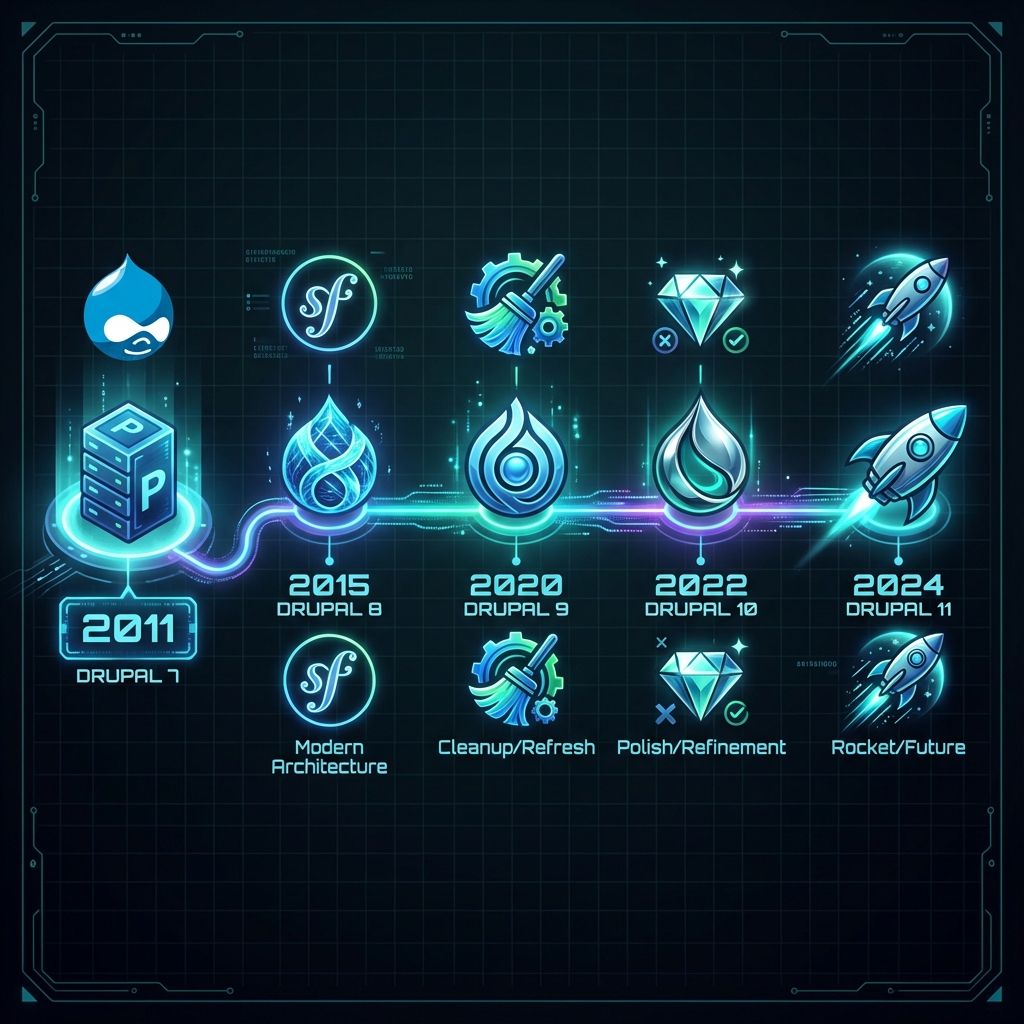
The Timeline: A Visual Journey
Let’s put this decade of transformation into perspective:
| Year | Version | Key Innovation |
|---|---|---|
| 2011 | D7 | Peak of classic Drupal |
| 2015 | D8 | Symfony integration, modern PHP |
| 2017 | D8.4 | Media module in core |
| 2019 | D8.7 | Layout Builder stable |
| 2020 | D9 | Easy upgrade path, dependency updates |
| 2021 | D9.2 | Experimental Olivero theme |
| 2022 | D10 | CKEditor 5, Olivero default |
| 2024 | D11 | Recipes, Experience Builder |
What This Means For You
If You’re on Drupal 7
Time is running out. Drupal 7’s end-of-life is January 2025.
Your options:
- Migrate to Drupal 10/11 — Significant effort, but future-proof
- Move to a commercial D7 extended support — Buys time, but temporary
- Replatform entirely — Sometimes the right choice
If You’re on Drupal 8/9
Upgrade now. The path to D10/11 is smooth, well-documented, and proven.
Tools to help:
- Upgrade Status module
- Rector PHP for automated code fixes
- Drupal Check for deprecation scanning
If You’re New to Drupal
You’re joining at the best possible time. Drupal 11 is:
- Easier to install
- Easier to theme
- Easier to extend
- Better documented than ever
The Lessons Learned
After analyzing this decade of transformation, here are the universal lessons for any long-lived software project:
1. Embrace External Dependencies
Drupal’s adoption of Symfony wasn’t surrender — it was wisdom. Use what exists. Focus your energy on what makes you unique.
2. Make Upgrades Easy
The D8→D9 deprecation strategy should be a template for every major software project. Warn users early. Provide migration paths. Don’t break their code without notice.
3. Community Over Code
Drupal’s survival isn’t about its technology. It’s about its community — thousands of contributors, hundreds of companies, decades of knowledge sharing.
4. Evolution > Revolution (Usually)
D8 was a revolution. Necessary, but painful. D9, D10, and D11 prove that steady evolution is often the better path.
5. Never Stop Modernizing
The moment you stop improving is the moment you start dying. Drupal’s continuous modernization keeps it relevant in a world of shiny new frameworks.
Conclusion: The Phoenix That Keeps Rising
I started this post with a question: What if a “dead” language’s CMS completed one of open source’s most ambitious transformations?
Now you’ve seen the answer.
Drupal isn’t just surviving. It’s thriving. It went from procedural spaghetti to modern architecture. From desktop-only admin to mobile-first interfaces. From difficult content editing to experiences that rival any SaaS platform.
But here’s what matters most:
Drupal did this while maintaining backwards compatibility, respecting its community, and staying true to its core values — flexibility, security, and enterprise-grade reliability.
The next time someone tells you PHP is dead, or that Drupal is outdated, or that you should rewrite everything in React — remember this story.
Remember that transformation is possible. That legacy doesn’t mean dead. That communities can move mountains when they work together.
And remember that sometimes, the best technology isn’t the newest one — it’s the one that refuses to stop getting better.
The Renaissance continues.
Did this article change how you think about Drupal? Share it with a developer who needs to see this story. And if you have your own Drupal transformation story, I’d love to hear it.