
What if I told you that the CMS everyone keeps declaring “dead” is quietly producing some of the highest-paid PHP developers in the industry?
Here’s what nobody talks about: while developers chase the latest JavaScript frameworks, Drupal specialists are commanding premium salaries, building systems that run governments, and enjoying a job security that “trendy” developers often envy.
This isn’t hype. This is data. And today, I’m going to give you everything you need to decide: Should YOU learn Drupal in 2026?
The Question Everyone’s Asking
Let me guess. You’ve heard conflicting things:
“Drupal is enterprise-grade and powers major corporations.”
“Drupal is too complex and outdated.”
“Drupal developers are in high demand!”
“Nobody uses Drupal anymore.”
So which is it?
Here’s my honest answer after years in this ecosystem: Drupal is not for everyone. But for the right developer, it’s a career accelerator like no other.
Let me help you figure out if you’re that developer.
Part I: The Honest Truth About Drupal in 2026
Who Should Learn Drupal
Let me be direct. Drupal is worth learning if you:
| ✅ You Should Learn Drupal If… | ❌ Skip Drupal If… |
|---|---|
| You want enterprise-level career | You want quick freelance gigs |
| You enjoy complex architectures | You prefer simple blog setups |
| You value job stability | You chase trendy frameworks |
| You think long-term (5+ years) | You need income within weeks |
| You appreciate structured systems | You prefer “move fast, break things” |
| You’re okay with steeper learning | You want instant gratification |
The Numbers Don’t Lie
Let’s look at the data that matters:
| Metric | Drupal Reality |
|---|---|
| Market Share | 1.6% of all websites (seems small, but…) |
| Enterprise Adoption | 40% of Fortune 500 use Drupal |
| Average Developer Salary (US) | $95,000 - $140,000/year |
| Remote Job Availability | 78% of Drupal jobs are remote-friendly |
| Job Postings (2024) | 12,000+ active listings globally |
| Typical Hourly Rate (Freelance) | $75 - $200/hour |
The insight here? Drupal’s small overall market share is deceptive. It dominates the high-value segment of the web — government, healthcare, higher education, large enterprises.
The Sites That Run On Drupal
This isn’t a CMS for hobby projects. These organizations chose Drupal:
- The White House (whitehouse.gov)
- NASA (nasa.gov)
- Tesla (tesla.com)
- The Grammy Awards (grammy.com)
- Harvard University (harvard.edu)
- The Economist (economist.com)
- NBC Universal
- Johnson & Johnson
Why does this matter? Because these organizations have infinite choices. They chose Drupal for security, scalability, and longevity.

Part II: The Drupal Learning Curve — What To Expect
The Uncomfortable Reality
Let me be brutally honest: Drupal has the steepest learning curve of any major CMS.
Here’s what that actually means:
| CMS | Time to Build First Site | Time to Mastery |
|---|---|---|
| WordPress | 1-2 days | 3-6 months |
| Squarespace | 2-4 hours | 1-2 weeks |
| Webflow | 1-2 days | 2-3 months |
| Drupal | 1-2 weeks | 12-24 months |
Before you close this tab, consider this: Higher barrier to entry = Less competition = Higher salaries.
The developers who push through Drupal’s learning curve enter a market with genuine scarcity. Companies need Drupal developers and can’t find enough qualified candidates.
Why Is Drupal Harder?
It’s not that Drupal is poorly designed. It’s that Drupal is designed for different problems:
WordPress Mental Model:
"Here's a blog. Add some plugins. Done."

Drupal Mental Model:
"Here's a content modeling system.
Define your entities, configure relationships,
build views, establish permissions,
create workflows, then... use it for whatever you need."
Drupal doesn’t assume what you’re building. It gives you primitives to build anything. That power comes with complexity.
The Psychology of Learning Drupal
Here’s what the learning journey actually feels like:
Week 1-2: “This is interesting. A bit confusing, but I’m getting it.”
Week 3-4: “Why are there so many ways to do things? This is overwhelming.”
Month 2: “I think I understand… no wait, I don’t.”
Month 3-4: “OH. It’s all connected. The caching, the entity system, the hooks…”
Month 6+: “This is actually brilliant. I can build anything.”
Month 12+: “I can’t imagine using anything less powerful for serious projects.”
This is the Drupal J-curve. Your productivity dips before it skyrockets. Those who quit during the dip never experience the acceleration.
Part III: The Complete Drupal Learning Roadmap
Now we get to the treasure. Here’s the roadmap I wish I had when starting — organized into 6 phases, each building on the previous.
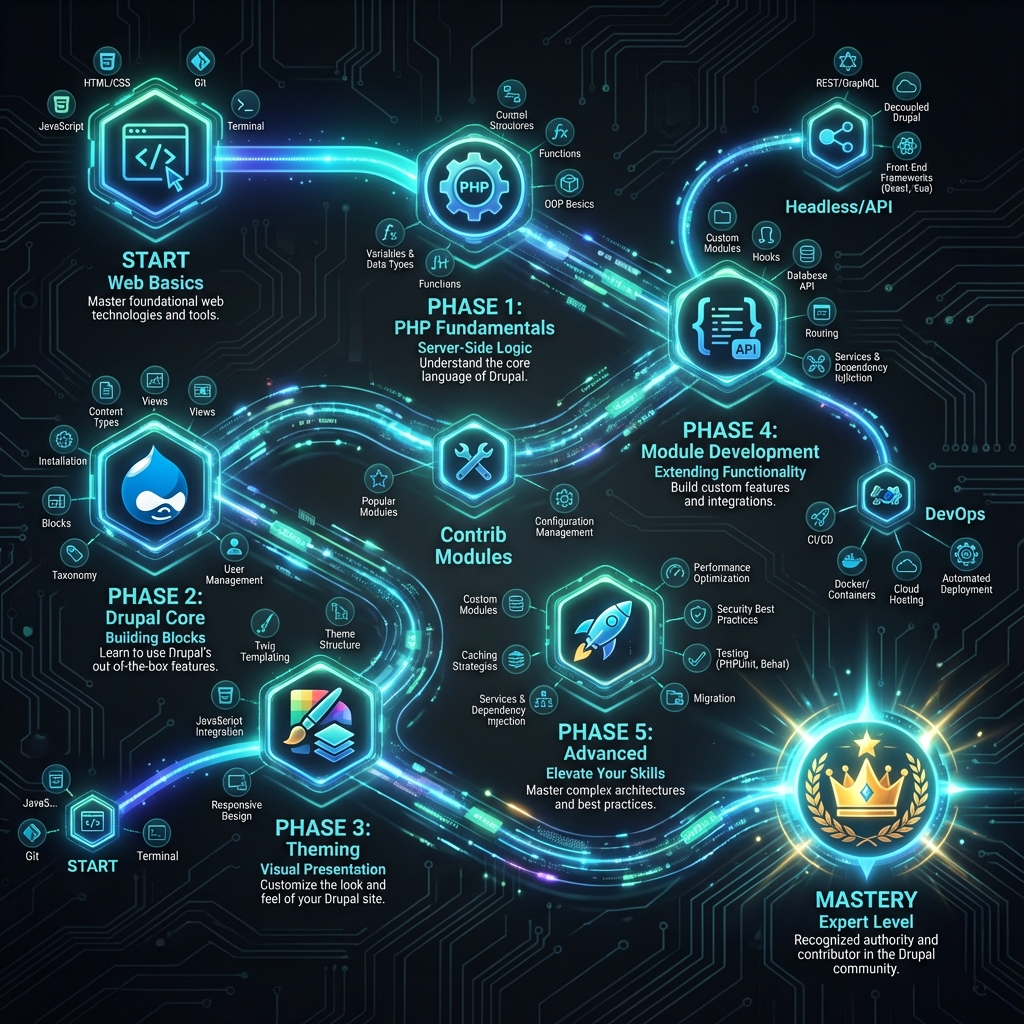
Phase 0: Prerequisites (1-3 months)
Don’t skip this. Many Drupal beginners struggle not because Drupal is hard, but because they’re missing foundational skills.
| Skill | Why You Need It | Resource |
|---|---|---|
| HTML/CSS | Every theme you build | freeCodeCamp, MDN |
| Basic PHP | Drupal is PHP-based | PHP: The Right Way |
| Command Line | Drupal CLI tools are essential | Linux Journey |
| Git Basics | Version control is mandatory | Git Immersion |
| MySQL/SQL | Understanding the data layer | SQLBolt |
Time Investment: If you’re starting from zero, budget 2-3 months here. If you’re already a web developer, you might need just a refresher week.
# Test yourself: Can you do these?
php -v                    # Check PHP is installed
composer --version        # Package management
mysql -u root -p          # Database access
git status                # Version control
Phase 1: Drupal Site Building (2-3 months)
This is where you learn Drupal’s admin interface — no code yet, just configuration.
Core Concepts to Master:
-
Content Types & Fields
- Creating custom content types
- Field types (text, image, reference, etc.)
- Field display configuration
-
Taxonomy
- Vocabularies and terms
- Hierarchical vs flat taxonomies
- Term reference fields
-
Views
- Drupal’s query builder
- Displays: Page, Block, Feed
- Relationships and contextual filters
-
User Roles & Permissions
- Role creation
- Granular permission assignment
- Content workflow states
-
Blocks & Layouts
- Block placement
- Layout Builder basics
- Region configuration
Project Milestone: Build a complete portfolio website with:
- Custom “Project” content type
- Category taxonomy
- Portfolio view with filters
- Contact form integration
# Example: Defining a "Project" content type
Project:
  fields:
    - title: Text (required)
    - body: Long text with summary
    - images: Media reference (multiple)
    - client: Text
    - completion_date: Date
    - project_url: Link
    - technologies: Taxonomy reference
    - featured: Boolean
Phase 2: Drupal Theming (2-4 months)
Now you make Drupal look like anything you want.
Core Skills:
| Skill | Description |
|---|---|
| Twig Templating | Drupal’s theme engine |
| Theme Structure | .info.yml, templates, libraries |
| CSS/JS Libraries | Attaching assets properly |
| Preprocessing | hook_preprocess functions |
| Template Suggestions | Debug mode, template overrides |
| Breakpoints | Responsive image handling |
A Taste of Twig:
{# node--article--teaser.html.twig #}
<article{{ attributes.addClass('article-teaser') }}>
  <div class="article-teaser__image">
    {{ content.field_image }}
  </div>

  <div class="article-teaser__content">
    <h2 class="article-teaser__title">
      <a href="{{ url }}">{{ label }}</a>
    </h2>

    <div class="article-teaser__meta">
      {% trans %}Posted on {{ date }}{% endtrans %}
    </div>

    {{ content.body }}

    <a href="{{ url }}" class="article-teaser__readmore">
      {% trans %}Read more{% endtrans %}
    </a>
  </div>
</article>
Project Milestone: Create a custom theme from scratch:
- Custom base theme (not a sub-theme)
- Responsive navigation
- Custom View templates
- Integrated component library
Phase 3: Drupal Module Development (3-6 months)
This is where Drupal becomes truly unlimited. You learn to extend core functionality with custom PHP code.
Core Concepts:
-
Module Structure
my_module/ ├── my_module.info.yml ├── my_module.module ├── my_module.routing.yml ├── my_module.services.yml ├── src/ │ ├── Controller/ │ ├── Form/ │ ├── Plugin/ │ └── Service/ └── templates/ -
The Hook System (legacy but important)
/** * Implements hook_form_alter(). */ function my_module_form_alter(&$form, $form_state, $form_id) { if ($form_id === 'user_login_form') { $form['name']['#description'] = t('Enter your email address.'); } } -
Symfony Services (modern approach)
// src/Service/ProjectAnalyzer.php namespace Drupal\my_module\Service; use Drupal\Core\Entity\EntityTypeManagerInterface; class ProjectAnalyzer { protected EntityTypeManagerInterface $entityTypeManager; public function __construct(EntityTypeManagerInterface $entity_type_manager) { $this->entityTypeManager = $entity_type_manager; } public function getProjectStats(): array { $storage = $this->entityTypeManager->getStorage('node'); $query = $storage->getQuery() ->condition('type', 'project') ->condition('status', 1) ->accessCheck(TRUE); return [ 'total' => $query->count()->execute(), 'featured' => $query->condition('field_featured', 1)->count()->execute(), ]; } } -
Plugin System
- Blocks
- Field formatters
- Field widgets
- Queue workers
- REST resources
Project Milestone: Build a custom module that:
- Adds a custom REST endpoint
- Integrates with an external API
- Provides custom blocks
- Includes PHPUnit tests
Phase 4: Advanced Drupal (3-6 months)
Now you become a senior-level Drupal developer.
Topics to Master:
| Domain | Skills |
|---|---|
| Performance | Caching strategies, BigPipe, lazy builders |
| Security | Input sanitization, CSRF protection, permissions |
| APIs | JSON:API, GraphQL, custom REST |
| DevOps | Docker, CI/CD, automated testing |
| Migration | Migrating from D7, external sources |
| Multilingual | Translation workflows, language negotiation |
Code Example — Custom Cache Contexts:
// Make a block vary by user's organization
// src/Cache/Context/UserOrganizationCacheContext.php

namespace Drupal\my_module\Cache\Context;

use Drupal\Core\Cache\Context\CacheContextInterface;
use Drupal\Core\Session\AccountInterface;

class UserOrganizationCacheContext implements CacheContextInterface {

  protected AccountInterface $currentUser;

  public function __construct(AccountInterface $current_user) {
    $this->currentUser = $current_user;
  }

  public static function getLabel() {
    return t('User organization');
  }

  public function getContext() {
    // Return the user's organization ID for cache variance
    return $this->getUserOrganization($this->currentUser);
  }

  public function getCacheableMetadata() {
    return new CacheableMetadata();
  }
}
Phase 5: Specialization Tracks
At this point, you choose your niche:
| Track | Focus | Career Path |
|---|---|---|
| Headless/Decoupled | Next.js + Drupal, JSON:API | Modern agency work |
| Enterprise Architecture | Multi-site, scaling, governance | Large corp positions |
| Contrib Maintainer | Open-source contribution | Community recognition |
| Drupal DevOps | DDEV, Platform.sh, Acquia | Infrastructure roles |
| Migration Specialist | D7 → D10/11, data migration | High-demand consulting |
Phase 6: Continuous Mastery
Drupal evolves. So must you.
Stay Current:
- Follow Drupal Core issues on drupal.org
- Attend DrupalCon (virtual or in-person)
- Participate in local Drupal meetups
- Contribute to contrib modules
- Read “The Weekly Drop” newsletter
Part IV: Essential Resources — The Curated List
Free Resources
| Resource | Type | Best For |
|---|---|---|
| Drupal.org Documentation | Official Docs | Reference |
| Drupalize.Me Free Videos | Video | Beginners |
| Debug Academy YouTube | Video | Practical tutorials |
| Drupal Easy Podcast | Audio | Industry insights |
| Talking Drupal Podcast | Audio | Core developments |
| r/drupal | Community | Questions, discussions |
| Drupal Slack | Chat | Real-time help |
Paid Resources (Worth Every Penny)
| Resource | Cost | Why It’s Worth It |
|---|---|---|
| Drupalize.Me | $45/month | Most comprehensive library |
| OSTraining | $99/year | Structured courses |
| Debug Academy | $3,500+ | Bootcamp-style, job guarantee |
| Symfonycasts | $25/month | Essential for module dev |
| Acquia Certification | $300-500 | Career credential |
Essential Tools
# Local Development
DDEV             # Docker-based local environment
Lando            # Alternative to DDEV

# Package Management
Composer         # PHP dependency manager
Drush            # Drupal command-line tool
Drupal Console   # Code generation

# IDE
PHPStorm         # Best Drupal IDE (paid)
VS Code + PHP    # Free alternative

# Debug
Xdebug           # PHP debugging
Devel module     # Drupal debugging
Webprofiler      # Performance profiling
Part V: Common Mistakes (And How To Avoid Them)
Mistake #1: Skipping Core Concepts
The Error: Jumping straight to module development without understanding site building.
The Fix: Spend at least 2 months on admin-only configuration. You’ll write better code after understanding what Drupal does without code.
Mistake #2: Fighting Drupal
The Error: Trying to make Drupal work like WordPress or Laravel.
The Fix: Embrace Drupal’s patterns even if they feel foreign. There are valid reasons behind its architecture.
// ❌ Fighting Drupal (direct database queries)
$result = \Database::getConnection()
  ->query("SELECT * FROM node WHERE type = 'article'");

// ✅ Embracing Drupal (Entity API)
$nodes = \Drupal::entityTypeManager()
  ->getStorage('node')
  ->loadByProperties(['type' => 'article']);
Mistake #3: Ignoring Contrib
The Error: Building custom solutions for solved problems.
The Fix: Before writing code, search drupal.org. 90% of functionality you need exists as contributed modules.
Mistake #4: Learning in Isolation
The Error: Studying alone without community interaction.
The Fix: Join Drupal Slack, attend meetups, contribute patches. The community accelerates learning dramatically.
Mistake #5: Neglecting DevOps
The Error: Manual deployments and no version control.
The Fix: Learn DDEV, Git workflows, and config management from day one. These skills matter at every level.
Part VI: Career Paths & Salary Expectations
Entry Level (0-2 years)
| Role | Typical Salary (US) | Focus |
|---|---|---|
| Junior Drupal Developer | $55,000 - $75,000 | Site building, theming |
| Drupal Site Builder | $50,000 - $70,000 | Configuration, no code |
| Support Developer | $45,000 - $65,000 | Maintenance, bug fixes |
Mid Level (2-5 years)
| Role | Typical Salary (US) | Focus |
|---|---|---|
| Drupal Developer | $80,000 - $110,000 | Custom modules, theming |
| Drupal Themer | $75,000 - $100,000 | Front-end specialization |
| Drupal Consultant | $90,000 - $130,000 | Solutions architecture |
Senior Level (5+ years)
| Role | Typical Salary (US) | Focus |
|---|---|---|
| Senior Drupal Developer | $120,000 - $160,000 | Full-stack, architecture |
| Drupal Architect | $140,000 - $180,000 | System design, governance |
| Technical Lead | $150,000 - $200,000 | Team leadership, strategy |
| Independent Consultant | $150 - $250/hour | Enterprise advisory |
Top Employers
- Acquia — The Drupal company (founded by Drupal’s creator)
- Lullabot — Premier Drupal agency
- Palantir.net — Large-scale implementations
- Phase2 — Enterprise solutions
- Pantheon — Drupal hosting platform
- Government contractors — Large public sector demand
Part VII: The Final Verdict
So, should you learn Drupal in 2026?
Yes, if:
- You’re building a long-term career, not chasing short-term trends
- You value depth over breadth in your skillset
- You’re drawn to complex problem-solving
- You want to work on high-impact projects for major organizations
- You can commit to 12+ months of consistent learning
- You appreciate job security and salary premium
No, if:
- You need to start earning immediately
- You prefer building simple marketing sites
- You’d rather learn multiple technologies broadly
- You want the lowest possible barrier to entry
- You prioritize trendiness over stability
My Personal Take
After working in this ecosystem for years, here’s what I know: Drupal developers are a different breed. They tend to be more experienced, more methodical, and more comfortable with complexity than the average web developer.
That’s not arrogance — it’s self-selection. The learning curve filters for developers who are serious about their craft.
If that sounds like you, Drupal might be the best career decision you make.
The organizations that run on Drupal — governments, universities, healthcare systems, Fortune 500 companies — aren’t going anywhere. And neither are the developers who serve them.
Your First Step
Ready to begin? Here’s your immediate action plan:
- This week: Install DDEV and spin up a local Drupal 11 site
- This month: Complete the official “User Guide” on drupal.org
- First 90 days: Build 3 complete sites (portfolio, blog, e-commerce simulation)
- First year: Develop one custom module, contribute one patch to a contrib project
The mountain is tall. But the view from the top?
Absolutely worth the climb.
Did this guide help you decide? Have questions about the learning path? Drop a comment or reach out — I’d love to hear where you are on your Drupal journey.