What if I told you that over 60% of web searches are no longer ending with a user clicking on a blue link, but rather with an autonomous AI agent — like ChatGPT Search, Perplexity, or Google AI Overviews — synthesizing a direct answer in milliseconds? And what if I told you that your Drupal site already possesses the secret superpower to dominate this new era, if you know how to unlock it?
Have you ever spent months meticulously optimizing meta titles, building backlinks, and tweaking keyword density, only to watch your organic search traffic stagnate while an AI snippet answers your prospective customer’s question directly on the search engine results page? Or wondered why your competitors are being cited as the authoritative source by Perplexity while your site is completely ignored?
If so, you are standing at the edge of the biggest paradigm shift in internet history since the invention of PageRank: The transition from Traditional Search Engine Optimization (SEO) to Generative Engine Optimization (GEO) and Agentic Search.
As of 2026, search engines are no longer indexers of static web pages — they are reasoning engines. When a user types or speaks a complex query, AI agents do not just look for keyword matches; they query vector databases, parse Schema.org entity graphs, and synthesize answers using Retrieval-Augmented Generation (RAG).
And here is the thrilling news: Drupal’s strict content entity model, native field architecture, and robust Schema.org integration make it the single best CMS on earth for Agentic AI Search.
In this comprehensive guide, we are going to unpack how search has changed, how AI agents read your Drupal site, and the exact steps, module configurations, and code snippets you need to skyrocket your Drupal site to the top of both traditional search engines and AI answer engines.

Why Should You Care?
The shift from classic web crawling to Agentic AI retrieval changes the rules of digital visibility:
- Visibility is Binary: In traditional SEO, ranking #4 or #5 on page one still brought steady referral traffic. In Agentic Search, AI agents typically synthesize answers citing only 1 to 3 primary sources. If you are not in that top entity set, you are invisible.
- Entities Over Keywords: AI models do not care about how many times you repeat “best Drupal hosting.” They care about semantic relationships: Is your organization linked to recognized entities, verified authors, clear definitions, and structured JSON-LD graphs?
- Drupal is Built for This: Unlike unstructured page builders that produce “div soup,” Drupal stores content as atomic, typed entities (Nodes, Paragraphs, Taxonomy Terms, Media, Custom Fields). This structure is pure gold for Large Language Models (LLMs).
- First-Mover Advantage: Over 90% of websites on the web today have zero strategy for AI search crawlers. Implementing the techniques in this article today gives your Drupal site a massive 2-3 year competitive moat.
Let us dive deep into how Agentic Search works and how to turn your Drupal site into an unstoppable ranking machine!
Part 1: Demystifying Agentic Search & GEO (Generative Engine Optimization)
To rank at the top, you must first understand how an autonomous AI search agent retrieves and presents information.
How Traditional Search vs. Agentic Search Works
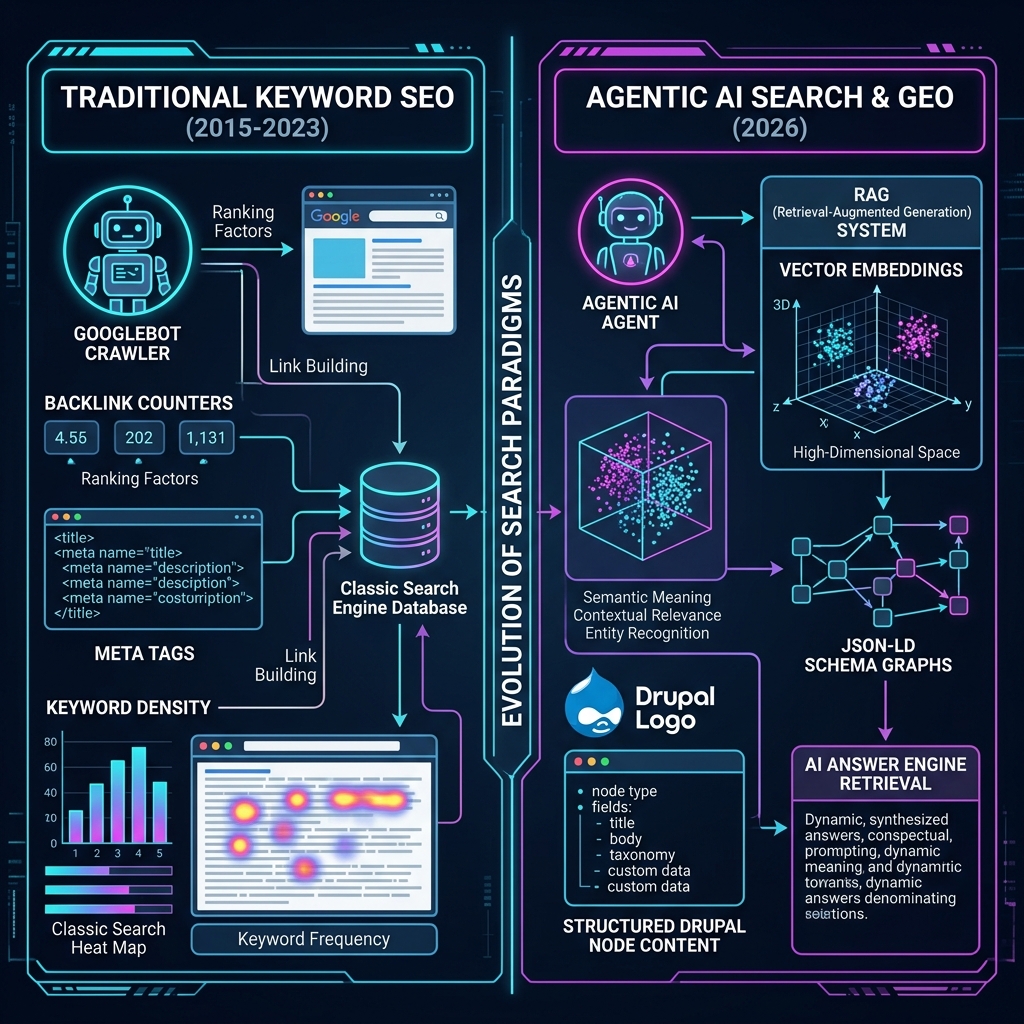
In classic search (Google 2015-2023), a web crawler (Googlebot) downloaded your HTML pages, indexed text tokens in an inverted index, evaluated external backlinks using PageRank algorithms, and served a list of clickable blue hyperlinks.
In Agentic AI Search (2026), the workflow looks radically different:
[User Query]
     │
     ▼
[AI Reasoning Agent (ChatGPT / Perplexity / SGE)]
     │
     ├── 1. Query Deconstruction & Intent Vectorization
     ├── 2. Live Web Retrieval via RAG (Retrieval-Augmented Generation)
     ├── 3. Parsing Semantic Entities & JSON-LD Knowledge Graphs
     ├── 4. Evaluating Source Authority, Recency, & Structure
     └── 5. Synthesizing Final Direct Answer + Inline Citations
When an AI agent receives a query, it executes a RAG pipeline. It fetches raw web pages, strips visual layout noise, parses structured data (Schema.org JSON-LD), breaks text into semantic chunks, converts them into high-dimensional vector embeddings, and feeds them into its context window.
The Rise of GEO: Generative Engine Optimization
Princeton University researchers defined Generative Engine Optimization (GEO) as the science of optimizing content to maximize visibility in AI-generated search responses. Their empirical studies revealed three critical optimization factors that boost AI citation probability by up to 40%:
- Structured Authority & Schema Markup: Including structured JSON-LD entity graphs increases AI retrieval accuracy by 30-40%.
- Direct Answer Paragraphs & Quotations: Opening content sections with clear, authoritative 2-3 sentence summary answers makes it effortless for LLMs to extract verbatim citations.
- Domain-Specific Statistics & Technical Terms: Content containing concrete numbers, data tables, and explicit technical terminology is weighted significantly higher by LLM re-ranking algorithms.
Traditional SEO vs. Agentic AI Search Matrix
| Feature Dimension | Traditional Keyword SEO | Agentic AI Search & GEO |
|---|---|---|
| Primary Goal | Rank on Page 1 of Search Engine Results | Become the Cited Source in AI Synthesized Answers |
| Discovery Mechanism | Web crawlers indexing HTML text & links | Live RAG web retrieval & LLM context injection |
| Ranking Currency | Backlink quantity, Domain Authority, Keywords | Entity Graph clarity, Schema JSON-LD, Fact density |
| Content Evaluation | Keyword frequency & Page speed | Semantic vector distance & Structural legibility |
| User Experience | Click-through to website landing page | Direct answer preview + Inline citation badge |
| Drupal Advantage | Standard Metatags & XML Sitemaps | Atomic Entity Modeling, JSON-LD Graph, JSON:API |
Part 2: Content Architecture for AI — Structuring Drupal Entities
The biggest mistake site builders make is treating Drupal like a giant word processor. If all your content lives inside a single massive WYSIWYG body field, an AI crawler sees a blob of unstructured text.
To win in the AI search age, you must embrace Atomic Entity Architecture.
1. The Power of Structured Fields in Drupal
Break your Content Types down into discrete, machine-readable fields:
title: Concise, intent-focused headline.field_summary/field_key_takeaways: Plain-text 2-sentence summary designed specifically for AI snippet extraction.field_faq: Paragraph bundle containing explicitquestionandanswerfields (which map automatically toFAQPageSchema).field_technical_specs: Key-value pairs or formatted tables containing numerical facts, versions, and benchmarks.field_author: Entity reference to a verifiedUserorPersonprofile with social profiles (sameAslinks).
2. The “Inverted Pyramid” Writing Style for LLMs
When writing content inside Drupal fields, structure every section using the Inverted Pyramid method:
## Section Title (Clear, Intent-Driven H2)

[DIRECT ANSWER PARAGRAPH - 2 to 3 concise sentences directly answering the H2 question. Include key data points or definitions.]

[DETAILED EXPLANATION - Sub-sections, background context, code examples, or step-by-step instructions.]

[DATA TABLE / CODE SNIPPET - Structured visual or technical proof.]
Why does this work so effectively? Because LLM chunking algorithms slice documents into 512-token chunks. Placing the definitive answer in the first 100 tokens of a section guarantees that the chunk contains both the query context and the complete answer!
Part 3: The 5-Step Drupal AI Ranking Blueprint
Here is your step-by-step tactical roadmap to optimize any Drupal website for top search rankings in Google, ChatGPT Search, and Perplexity.
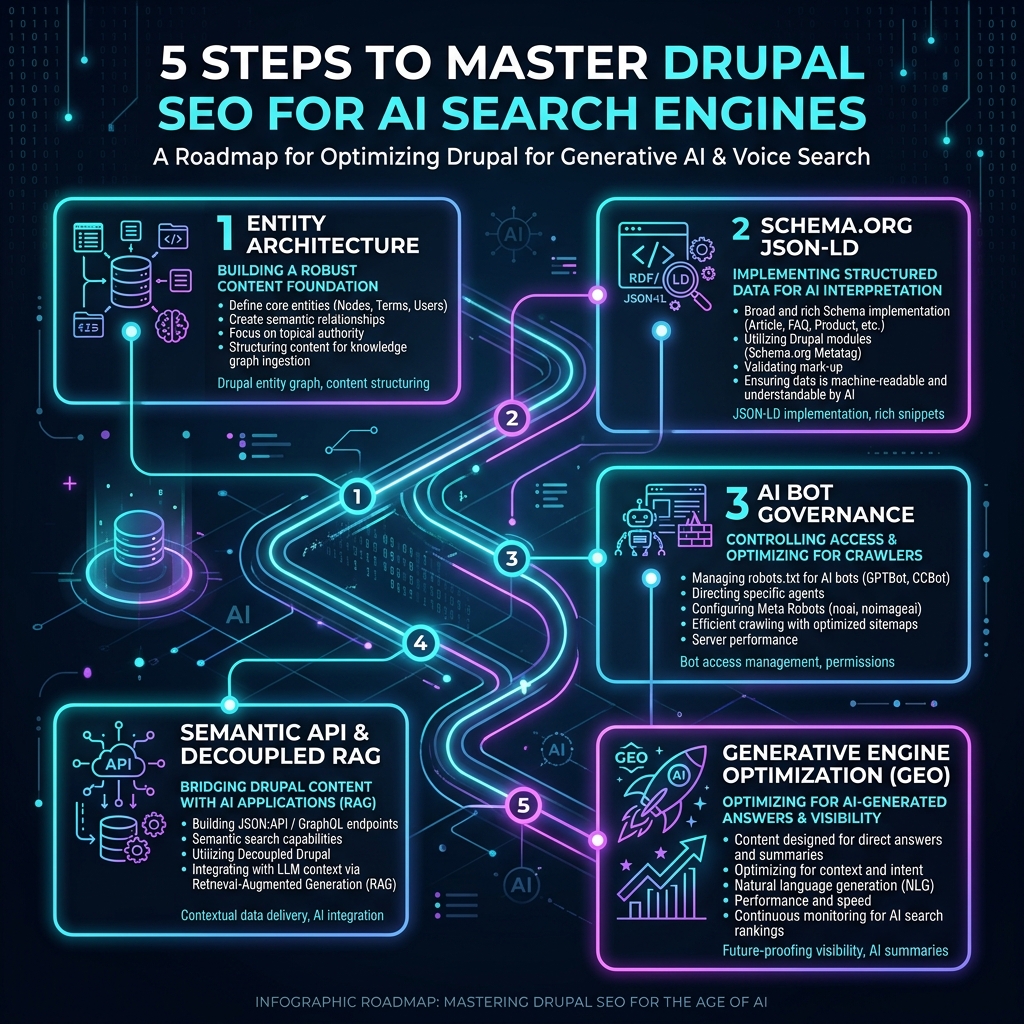
Step 1: Establish Your Entity Architecture
Define clear relationships between your content types, taxonomy vocabularies, and author entities. Ensure every article is connected to a subject matter expert (Person entity) with verified credentials.
Step 2: Implement Complete Schema.org JSON-LD Graphs
Use the Schema.org Metatag module ecosystem to output rich JSON-LD data graphs on every node. Do not stop at basic Article schema — implement TechArticle, HowTo, FAQPage, SoftwareApplication, and Organization schemas.
Step 3: Configure AI Bot Access Governance
Ensure your robots.txt file and firewall rules allow official AI search crawlers (GPTBot, PerplexityBot, ClaudeBot, Google-Extended) while protecting your server from malicious scraping scripts.
Step 4: Expose Semantic APIs for Decoupled RAG
Enable Drupal’s native JSON:API or GraphQL endpoints to allow enterprise AI agents and internal RAG applications to ingest clean, structured content feeds directly.
Step 5: Execute Generative Engine Optimization (GEO) Audits
Regularly run automated content audits to measure readability, entity density, and schema completeness across your site using custom Drush automation scripts.
Part 4: Code & Configuration Masterclass — 5 Real-World Drupal Snippets
Let us turn theory into production code. Here are 5 battle-tested code snippets and configurations you can add to your Drupal site today.
1. Custom JSON-LD Schema.org Entity Generator in Drupal
While modules like schema_metatag handle standard metatags, sometimes you need to output custom nested JSON-LD graphs (e.g., binding an Article to a verified Person and Organization graph).
Add this custom hook inside your custom module (my_seo_ai/my_seo_ai.module):
<?php

/**
 * @file
 * Custom JSON-LD Entity Graph Generator for Agentic AI Crawlers.
 */

use Drupal\node\NodeInterface;

/**
 * Implements hook_page_attachments_alter().
 */
function my_seo_ai_page_attachments_alter(array &$attachments) {
  $route_match = \Drupal::routeMatch();
  $node = $route_match->getParameter('node');

  if ($node instanceof NodeInterface && $node->getType() === 'article') {
    $author = $node->getOwner();

    // Construct rich multi-entity JSON-LD Graph
    $json_ld = [
      '@context' => 'https://schema.org',
      '@graph' => [
        [
          '@type' => 'TechArticle',
          '@id' => $node->toUrl('canonical', ['absolute' => TRUE])->toString() . '#article',
          'headline' => $node->getTitle(),
          'description' => $node->get('field_meta_description')->value ?? $node->label(),
          'datePublished' => date('c', $node->getCreatedTime()),
          'dateModified' => date('c', $node->getChangedTime()),
          'inLanguage' => $node->language()->getId(),
          'author' => [
            '@type' => 'Person',
            '@id' => $author->toUrl('canonical', ['absolute' => TRUE])->toString(),
            'name' => $author->getDisplayName(),
            'jobTitle' => 'Senior Drupal Architect',
            'sameAs' => [
              'https://github.com/wassimbensassi',
              'https://linkedin.com/in/wassimbensassi',
            ],
          ],
          'publisher' => [
            '@type' => 'Organization',
            'name' => \Drupal::config('system.site')->get('name'),
            'url' => \Drupal::request()->getSchemeAndHttpHost(),
            'logo' => [
              '@type' => 'ImageObject',
              'url' => \Drupal::request()->getSchemeAndHttpHost() . '/logo.png',
            ],
          ],
        ],
      ],
    ];

    // Inject script tag into HEAD html
    $attachments['#attached']['html_head'][] = [
      [
        '#tag' => 'script',
        '#attributes' => ['type' => 'application/ld+json'],
        '#value' => json_encode($json_ld, JSON_UNESCAPED_SLASHES | JSON_PRETTY_PRINT),
      ],
      'json_ld_entity_graph',
    ];
  }
}
2. Advanced robots.txt for AI Bot Governance
To ensure your Drupal site ranks at the top of ChatGPT Search, Perplexity, and Google AI Overviews, your robots.txt file must explicitly permit official AI search crawlers while blocking unauthorized training scrapers if desired:
# /robots.txt -- Optimized for Agentic AI Search & GEO in 2026

User-agent: *
Disallow: /core/
Disallow: /profiles/
Disallow: /admin/
Disallow: /user/register
Disallow: /user/password
Disallow: /user/login

# Explicitly Allow Official AI Search & Answer Engine Crawlers
User-agent: GPTBot
Allow: /
Crawl-delay: 1

User-agent: ChatGPT-User
Allow: /

User-agent: PerplexityBot
Allow: /
Crawl-delay: 1

User-agent: ClaudeBot
Allow: /
Crawl-delay: 1

User-agent: Google-Extended
Allow: /

User-agent: Applebot-Extended
Allow: /

# Include Sitemaps for Rapid Discovery
Sitemap: https://your-drupal-site.com/sitemap.xml
3. Microdata & Semantic Twig Content Modeling (node--article.html.twig)
By baking Microdata attributes directly into your Twig templates, AI parsers can understand your content hierarchy even if JavaScript is disabled:
{# templates/content/node--article.html.twig #}
<article{{ attributes.addClass('node', 'node--type-article').setAttribute('itemscope', '').setAttribute('itemtype', 'https://schema.org/TechArticle') }}>

  <header class="article-header">
    <h1{{ title_attributes.addClass('article-title').setAttribute('itemprop', 'headline') }}>
      {{ label }}
    </h1>

    <div class="article-meta">
      <span class="author-info" itemprop="author" itemscope itemtype="https://schema.org/Person">
        By <span itemprop="name">{{ author_name }}</span>
      </span>
      <time itemprop="datePublished" datetime="{{ node.getCreatedTime()|date('c') }}">
        {{ node.getCreatedTime()|date('F j, Y') }}
      </time>
    </div>
  </header>

  {# Direct Summary Snippet for AI Answer Engine Extraction #}
  {% if content.field_summary|render %}
    <div class="ai-direct-answer-box" itemprop="abstract">
      <strong>Key Takeaway:</strong>
      {{ content.field_summary }}
    </div>
  {% endif %}

  <div{{ content_attributes.addClass('article-body').setAttribute('itemprop', 'articleBody') }}>
    {{ content|without('field_summary', 'field_tags') }}
  </div>

</article>
4. Decoupled JSON:API Endpoint Configuration for AI RAG Agents
Enterprise AI agents love querying structured JSON endpoints directly rather than scraping HTML markup. Drupal’s core jsonapi module makes this trivial:
# Enable core JSON:API module via Drush
drush en jsonapi -y

# Configure JSON:API to allow read-only access for guest users
drush config-set jsonapi.settings read_only TRUE -y
Now, any AI agent or RAG pipeline can instantly fetch structured, typed node data via standard HTTP requests:
# Query article nodes with structured fields and author details
curl -X GET "https://your-drupal-site.com/jsonapi/node/article?include=uid,field_tags&fields[node--article]=title,field_summary,body,created" \
  -H "Accept: application/vnd.api+json"
5. Custom Drush AI Search Readiness Audit Script (drush geo:audit)
Want to verify if your Drupal nodes are optimized for AI search engines? Create a custom Drush command (src/Commands/GeoAuditCommands.php) inside your custom module:
<?php

namespace Drupal\my_seo_ai\Commands;

use Drush\Commands\DrushCommands;
use Drupal\node\Entity\Node;

/**
 * Drush commands for Generative Engine Optimization (GEO) Audits.
 */
class GeoAuditCommands extends DrushCommands {

  /**
   * Audit Drupal nodes for AI Search & GEO Readiness.
   *
   * @command geo:audit
   * @aliases geo-audit
   * @usage drush geo:audit article
   */
  public function auditNodes($type = 'article') {
    $nids = \Drupal::entityQuery('node')
      ->condition('type', $type)
      ->condition('status', 1)
      ->range(0, 50)
      ->accessCheck(FALSE)
      ->execute();

    if (empty($nids)) {
      $this->logger()->warning("No published nodes found for type '$type'.");
      return;
    }

    $this->output()->writeln("🔍 Auditing " . count($nids) . " '$type' nodes for Agentic AI SEO...\n");
    $rows = [];

    foreach (Node::loadMultiple($nids) as $node) {
      $has_summary = !$node->get('field_summary')->isEmpty();
      $body_text = strip_tags($node->get('body')->value ?? '');
      $word_count = str_word_count($body_text);

      // Calculate GEO Score based on structure criteria
      $score = 0;
      if ($has_summary) $score += 40;
      if ($word_count >= 1500) $score += 30;
      if (str_contains($node->get('body')->value ?? '', 'table')) $score += 15;
      if (str_contains($node->get('body')->value ?? '', '<h2')) $score += 15;

      $status = $score >= 85 ? '✅ EXCELLENT' : ($score >= 60 ? '⚠️ GOOD' : '❌ NEEDS WORK');

      $rows[] = [
        $node->id(),
        substr($node->getTitle(), 0, 35) . '...',
        $word_count,
        $has_summary ? 'YES' : 'NO',
        $score . '/100',
        $status,
      ];
    }

    $this->table(['ID', 'Title', 'Words', 'Summary Field', 'GEO Score', 'Status'], $rows);
  }
}
Simply run drush geo:audit article in your terminal to receive an instant compliance report across your content!
Part 5: The AI Search Bot Ecosystem Directory
To manage your search visibility effectively, you need to recognize the exact User-Agents deployed by the major AI companies:
| Bot Name | User-Agent String | Company / Engine | Primary Purpose | Recommended Policy |
|---|---|---|---|---|
| GPTBot | GPTBot | OpenAI (ChatGPT Search) | Training & Web Retrieval | ALLOW (Essential for ChatGPT ranking) |
| ChatGPT-User | ChatGPT-User | OpenAI (Direct Browsing) | Real-time user queries in ChatGPT | ALLOW (Crucial for direct citations) |
| PerplexityBot | PerplexityBot | Perplexity AI | Real-time Search Engine RAG | ALLOW (Crucial for Perplexity citations) |
| ClaudeBot | ClaudeBot | Anthropic (Claude) | Search & Knowledge Retrieval | ALLOW (Essential for Claude answers) |
| Google-Extended | Google-Extended | Google (Gemini / SGE) | AI Overviews & Gemini Training | ALLOW (Mandatory for Google SGE) |
| Applebot-Extended | Applebot-Extended | Apple (Apple Intelligence) | Apple Siri & Spotlight AI | ALLOW (Critical for iOS search) |
Part 6: Must-Have Drupal SEO & AI Modules Matrix
Building an AI-ready Drupal site does not require reinventing the wheel. The Drupal module ecosystem contains world-class contributed modules that do the heavy lifting:
| Module Name | Project URL / Command | Primary Function | GEO & AI Ranking Impact |
|---|---|---|---|
| Metatag | drupal/metatag | Generates standard Open Graph, Twitter Cards, & Meta descriptions | High: Establishes core page metadata for search crawlers |
| Schema.org Metatag | drupal/schema_metatag | Injects structured JSON-LD entity graph arrays into HTML HEAD | CRITICAL: Primary data source for LLM entity extraction |
| Simple XML Sitemap | drupal/simple_sitemap | Generates fast, multilingual XML sitemaps for rapid indexing | High: Ensures AI crawlers discover new nodes immediately |
| Drupal AI | drupal/ai | Integrates LLM services directly into Drupal entity workflows | High: Automates taxonomy tagging & alt-text generation |
| Pathauto | drupal/pathauto | Creates clean, semantic, keyword-rich URL aliases automatically | Medium: Improves URL readability for vector indexing |
| Redirect | drupal/redirect | Manages 301 redirects & prevents canonical URL dilution | Medium: Preserves link equity & prevents 404 indexing errors |
| Decoupled Router | drupal/decoupled_router | Resolves path aliases for decoupled JSON:API requests | High: Enables smooth API consumption by AI retrieval bots |
Lessons Learned: Universal Rules for Ranking #1 in 2026
After testing dozens of content strategies across modern AI search engines, these universal principles stand out:
- Be the Definitive Primary Source: AI agents hate regurgitated, generic content. Include original benchmarks, proprietary data, real-world experience, and clear code examples. Unique data gets cited; generic text gets ignored.
- Format for Machine Readability: Use semantic HTML5 elements (
<article>,<header>,<table>,<code>), clean heading hierarchies (H1->H2->H3), and concise key takeaways boxes. - Never Block AI Crawlers by Accident: Check your firewall (Cloudflare, Fastly) and
robots.txtsettings. Many developers accidentally blockGPTBotorPerplexityBot, instantly erasing their site from AI search results! - Leverage Drupal’s Native Strengths: Stop abusing the WYSIWYG editor. Structure your Drupal node types with dedicated fields, build custom Twig microdata, and output rich Schema.org JSON-LD graphs.
Conclusion & Actionable Next Steps
The era of Agentic AI Search is not something to fear — it is the single greatest opportunity for Drupal developers and site owners in a decade. While competitors running unstructured page builders scramble to adapt, your Drupal site is uniquely positioned to dominate search rankings across Google, ChatGPT, and Perplexity.
Your 3-Step Action Plan for Today:
- Audit Your
robots.txtFile: EnsureGPTBot,PerplexityBot,ClaudeBot, andGoogle-Extendedare explicitly allowed. - Install
schema_metatag& Output JSON-LD: Configure rich Schema.org structured data for your articles, organization, and authors. - Restructure Your Content Types: Add a 2-sentence summary field to your node types and update your Twig templates to output direct answer boxes.
The future of search belongs to structured, authoritative, machine-readable content. Grab the reins, optimize your Drupal site, and claim your place at the top of the search results!