What if the most radical evolution in modern content management isn’t another headless JavaScript framework, but a total re-engineering of the hypermedia engine?
Have you ever spent weeks building a decoupled React frontend for a client, only to realize that the overhead of state hydration, routing synchronization, and API maintenance has swallowed your development velocity? We have all been there. You trade the simplicity of a unified backend for the complexity of two separate systems, often just to get a smooth, dynamic user experience.
The web is undergoing a massive correction. We are realizing that sending megabytes of JavaScript to the client just to update a search result or submit a form is a performance tax our users shouldn’t have to pay.
Welcome to the Drupal 12 paradigm.
Scheduled for release in the week of December 7, 2026, Drupal 12 represents a massive structural shift. By aligning itself with Symfony 8, embracing HTMX for ultra-lean client interactions, and introducing Experience Builder (XB), Drupal 12 is proving that a unified platform can be faster, more maintainable, and friendlier to content editors than a bloated decoupled stack.
Why Should You Care?
As a technical lead or senior developer, you are the gatekeeper of your organization’s technical debt.
If you treat major CMS updates as mere dependency upgrades, you will continually find yourself refactoring code that was outdated before it was even written. The architectural choices in Drupal 12—particularly the shift toward Single Directory Components (SDCs) and hypermedia-driven interfaces—are not optional aesthetic changes. They represent the new standard of web development.
By understanding these shifts now, you can:
- Stop building custom modules that rely on procedural jQuery and start writing clean, declarative HTML.
- Transition your design systems to SDCs, making them instantly compatible with the visual page builder.
- Modernize your PHP codebase to utilize constructor property promotion, strict type-checking, and readonly classes.
Let’s dissect the core innovations of this upcoming release.
Part 1: SDC and Experience Builder — Visual Assembly Without Code
For a long time, the biggest friction point in Drupal development was the gap between what developers built and what content editors saw. Layout Builder was a step forward, but it still felt disconnected from modern component-driven workflows.
Drupal 12 solves this by introducing Experience Builder (XB) as a cornerstone of the new Drupal CMS (formerly the Starshot initiative).
Experience Builder bypasses traditional form configuration. It reads Single Directory Component (SDC) definitions directly from your codebase and provides a React-powered drag-and-drop interface. Editors can assemble pages visually, while the system ensures the underlying data models remain clean and queryable.
The Code Evolution: Component Definitions
Instead of writing complex theme hook registrations, preprocessing variables, and separate template files, you declare your component properties using a JSON Schema-style YAML file inside your component directory.
Before: Procedural hook_theme and Preprocess Blocks (The Old Way)
/**
 * Implements hook_theme().
 */
function classic_theme_theme($existing, $type, $theme, $path) {
  return [
    'promo_card' => [
      'variables' => [
        'title' => NULL,
        'image' => NULL,
        'cta_text' => NULL,
        'cta_url' => NULL,
      ],
      'template' => 'blocks/promo-card',
    ],
  ];
}

// And in a preprocess hook...
function classic_theme_preprocess_promo_card(&$variables) {
  if (isset($variables['cta_url']) && !$variables['cta_url'] instanceof Url) {
    $variables['cta_url'] = Url::fromUri($variables['cta_url']);
  }
}
After: Single Directory Component Schema (The SDC / Experience Builder Way)
# templates/components/promo-card/promo-card.component.yml
$schema: https://git.drupalcode.org/project/drupal/-/raw/HEAD/core/assets/schemas/v1/metadata.schema.json
name: Promo Card
description: 'A premium visual promotional card component'
props:
  type: object
  required:
    - title
    - cta_url
  properties:
    title:
      type: string
      title: 'Headline'
    image_src:
      type: string
      title: 'Image Path'
    cta_text:
      type: string
      title: 'Button Text'
      default: 'Read More'
    cta_url:
      type: string
      title: 'Link Destination'
      format: uri-reference
By standardizing on SDC schemas, Experience Builder can instantly parse this metadata and generate visual edit forms for content editors, completely eliminating the need for custom block types or preprocess boilerplate.
Table 1: Content Assembly Paradigm Comparison
| Feature Metric | Legacy Layouts (Blocks/Paragraphs) | Drupal 12 Experience Builder (XB) |
|---|---|---|
| Editing Interface | Form-heavy, backend form redirects | Direct drag-and-drop live preview |
| Component Format | Custom configuration entities / plugins | Single Directory Components (SDC) |
| Markup Control | Distributed across template files | Contained within the SDC directory |
| Editor Autonomy | Low (relies heavily on backend templates) | High (visual configuration of layout & assets) |
Part 2: The HTMX Hypermedia Revolution
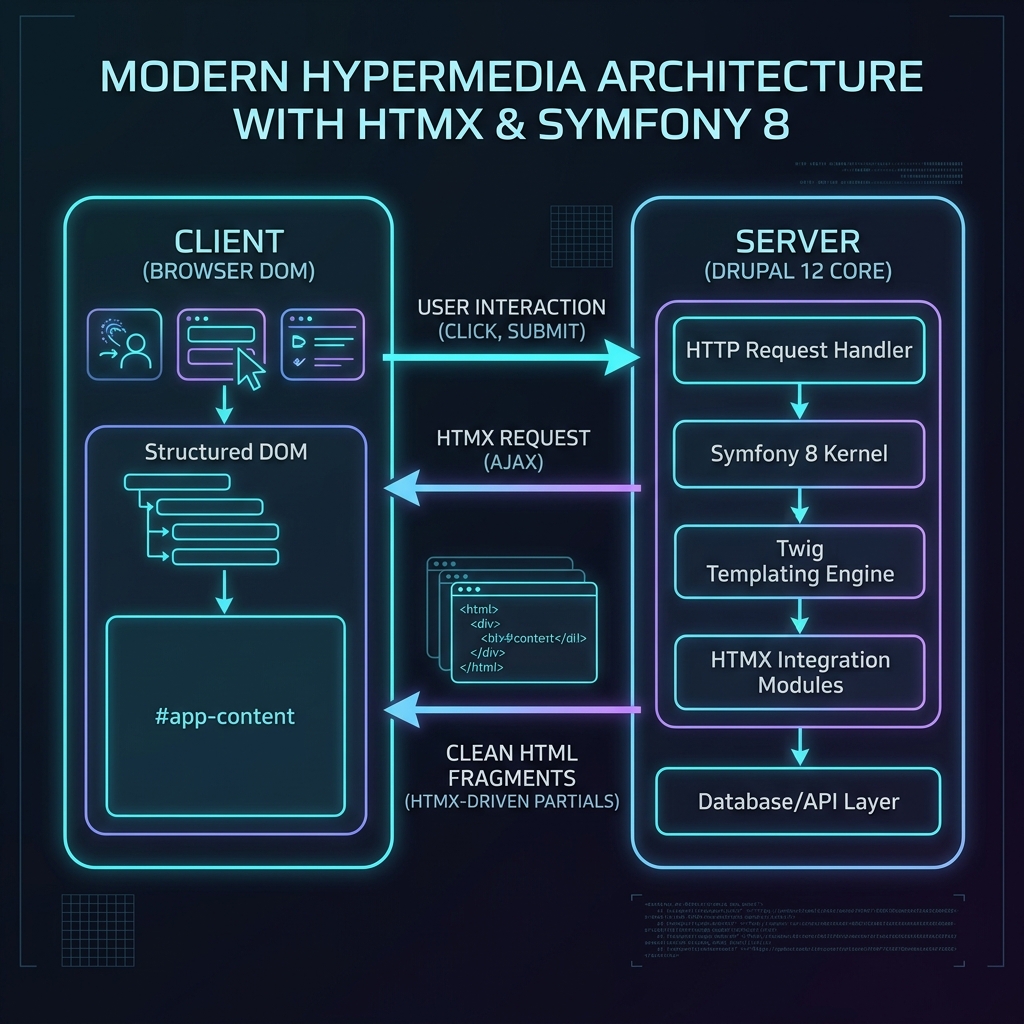
The inclusion of HTMX in the Drupal 12 ecosystem signals a major pivot away from heavy JavaScript client applications.
Rather than sending massive JS bundles (like React, Angular, or Vue) to the client to render dynamic interfaces, HTMX allows you to perform clean AJAX swaps, transition page states, and update parts of the DOM directly through HTML attributes.
The Code Evolution: Async Interactive Feeds
Let’s look at a search filter form that updates results asynchronously without reloading the page.
Before: Procedural AJAX Framework (The Old Way)
// In a Controller or Form definition
$form['category'] = [
  '#type' => 'select',
  '#options' => ['php' => 'PHP', 'drupal' => 'Drupal'],
  '#ajax' => [
    'callback' => '::filterResultsCallback',
    'wrapper' => 'results-container',
    'method' => 'replace',
  ],
];

public function filterResultsCallback(array &$form, FormStateInterface $form_state) {
  $response = new AjaxResponse();
  $filtered_content = $this->renderFilteredResults($form_state->getValue('category'));
  $response->addCommand(new ReplaceCommand('#results-container', $filtered_content));
  return $response;
}
After: Clean HTMX Integration (The Drupal 12 Way)
<!-- In your Twig component template -->
<div class="filter-panel">
  <select name="category"
          hx-get="/api/articles/filter"
          hx-target="#results-container"
          hx-trigger="change"
          hx-indicator="#loading-spinner">
    <option value="php">PHP</option>
    <option value="drupal">Drupal</option>
  </select>
</div>

<div id="results-container">
  {% include 'mytheme:article-list' with { articles: articles } %}
</div>

<span id="loading-spinner" class="htmx-indicator">Loading new updates...</span>
By replacing the complex PHP-driven AJAX framework with standard HTML attributes, the frontend remains simple and readable. The browser only needs to process lightweight HTML fragments, slashing client-side execution times.
Table 2: Frontend Performance Metrics
| Metric Analyzed | Classic Drupal AJAX | Drupal 12 + HTMX | Architectural Impact |
|---|---|---|---|
| JavaScript Dependency | jQuery + Core AJAX (~85 KB) | HTMX Core (~24 KB) | 71% reduction in initial JS execution |
| DOM Manipulation | Native JS execution via command queue | Direct HTML fragment swap | Snappier UI rendering, lower CPU load |
| State Syncing | Client-side tracking or session sync | Hypermedia state (server controls view) | Eliminates state mismatch bugs |
| Code Verbosity | High (Controllers + JS Behaviors) | Low (Pure Twig + HTML attributes) | Simpler debugging, faster developer onboarding |
Part 3: Under the Hood — Symfony 8 & Enforced Typings
Behind the scenes, Drupal 12 upgrades its foundational kernel to Symfony 8 and enforces support for modern PHP features (PHP 8.4+).
This engine upgrade ensures that your site benefits from the latest performance improvements, security protocols, and memory optimizations built into Symfony. However, it also means that legacy PHP constructs and loose variables will no longer compile without warnings or errors.
The Code Evolution: Dependency Injection
To compile on the Symfony 8 container, services must be declared with strict typing, constructor property promotion, and complete parameter definition.
Before: Procedural DI and Loose Variable Assignment
class ArticleFetcher {
  /**
   * @var \Drupal\Core\Database\Connection
   */
  protected $database;

  public function __construct($database) {
    $this->database = $database;
  }

  public function getArticles($limit = 10) {
    return $this->database->query("SELECT * FROM {node} LIMIT " . $limit)->fetchAll();
  }
}
After: Strictly Typed Promoted Properties (PHP 8.4 / Drupal 12)
declare(strict_types=1);

namespace Drupal\my_module\Service;

use Drupal\Core\Database\Connection;

final class ArticleFetcher {

  public function __construct(
    private readonly Connection $database
  ) {}

  public function getArticles(int $limit = 10): array {
    return $this->database
      ->select('node', 'n')
      ->fields('n')
      ->range(0, $limit)
      ->execute()
      ->fetchAll();
  }
}
By leveraging class promotion and strict type declarations, your codebase is highly optimized for Symfony’s compiled container. The JIT (Just-In-Time) compiler in modern PHP versions can optimize this code much more efficiently.
Table 3: System Engine & Dependencies
| Foundation Stack | Drupal 11 | Drupal 12 (Targeted) | Architectural Advantage |
|---|---|---|---|
| Minimum PHP | PHP 8.3 | PHP 8.4+ | Support for property hooks, asymmetric visibility |
| Framework Engine | Symfony 7 | Symfony 8 | Optimized container compiling, faster HTTP routing |
| Testing Harness | PHPUnit 10 | PHPUnit 11 | Advanced mock isolation, faster execution |
| JS API Management | Global library mapping | JS Import Maps | Native browser resolution of module dependencies |
Part 4: A Leaner Core — The Deprecation Sweep
With every major version release, Drupal does a thorough spring cleaning. Any APIs, modules, or themes that were marked as deprecated in Drupal 11 will be completely removed in Drupal 12.
This architectural pruning is crucial. Without it, the CMS would grow bloated and slow. For developers, this means you must audit your custom codebases before December 2026 to ensure you aren’t calling functions that no longer exist.
The Code Evolution: Event Hook Modernization
One area undergoing major cleanup is the event dispatching layer. Classic hooks are continuously being replaced by Symfony Event Subscribers.
Before: Legacy Procedural Hooks
/**
 * Implements hook_user_login().
 */
function my_module_user_login($account) {
  \Drupal::logger('my_module')->info('User logged in: ' . $account->getDisplayName());
}
After: Object-Oriented Event Subscribers
namespace Drupal\my_module\EventSubscriber;

use Symfony\Component\EventDispatcher\EventSubscriberInterface;
use Drupal\Core\Session\AccountEvents;
use Drupal\Core\Session\AccountEvent;
use Psr\Log\LoggerInterface;

final class UserLoginSubscriber implements EventSubscriberInterface {

  public function __construct(
    private readonly LoggerInterface $logger
  ) {}

  public static function getSubscribedEvents(): array {
    return [
      AccountEvents::USER_LOGIN => 'onUserLogin',
    ];
  }

  public function onUserLogin(AccountEvent $event): void {
    $account = $event->getAccount();
    $this->logger->info('User logged in: ' . $account->getDisplayName());
  }
}
Table 4: Projected Module Lifecycle Changes
| Core Module | Status in D12 | Contrib Replacement Path | Reason for Removal |
|---|---|---|---|
| Forum | Removed | forum (contrib) | Highly specialized; better suited as an extension |
| Statistics | Removed | statistics (contrib) or Matomo | Heavy write overhead; external analytics are preferred |
| Tracker | Removed | tracker (contrib) | High performance cost; rarely used on modern enterprise sites |
| Quick Edit | Removed | None (replaced by XB) | In-place editing is fully refactored under Experience Builder |
Part 5: The Roadmap to December 2026
Preparing for a major version release requires a structured strategy. You can’t wait until the week of the release to start testing your systems.
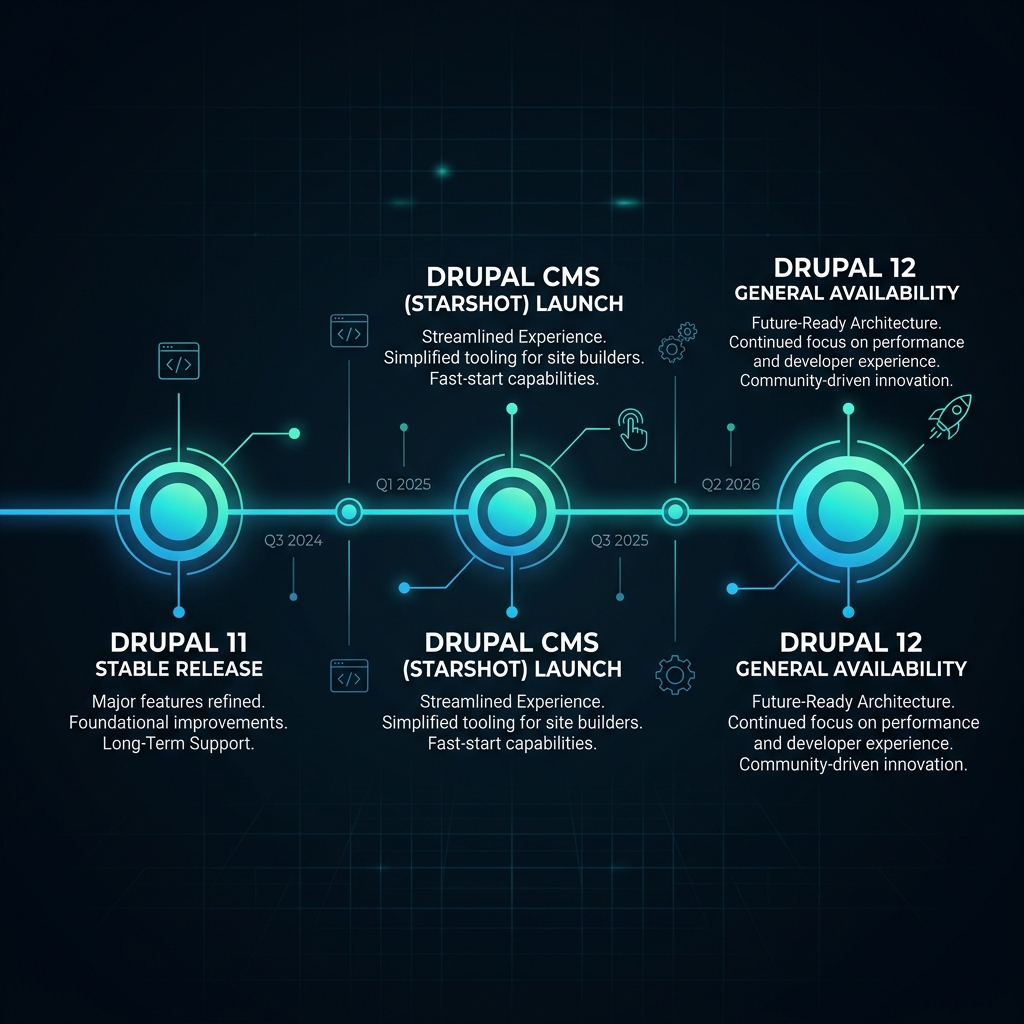
As the timeline illustrates, the release is preceded by crucial milestones:
- Q3 2024 to Q1 2025: The stabilization of Drupal 11.
- Q3 2025: The beta launch of Drupal CMS (incorporating early visual Experience Builder components).
- Q4 2026: The official release of Drupal 12.
Preparation Steps for Development Teams
- Leverage the Upgrade Status Module: Run the
upgrade_statusmodule on your current sites. It will identify deprecated code, incompatible libraries, and infrastructure configuration issues. - Transition from custom JS to HTMX: If you are writing custom jQuery code to handle simple backend fetches, refactor them using HTMX principles to prepare for the native Core integration.
- Strictly Enforce Typings: Ensure all new PHP code written by your team uses strict types. This will make your eventual compiler upgrade painless.
Lessons Learned from the Drupal 11 Transition
Reflecting on the recent transition from Drupal 10 to 11, several key lessons emerge:
- Third-Party Integrations are the Bottleneck: Core code is usually stable on day one. The challenge lies in your custom integrations, API bridges, and contributed modules. Start tracking issues on Drupal.org for critical modules early.
- Continuous Integration is Essential: Teams that integrated deprecation checks directly into their pull request workflows had a significantly easier upgrade path than those who ran audits manually at the end of the lifecycle.
- Visual Builder Alignment is Key: Don’t build complex, highly customized templates that can’t be easily parsed by visual layout systems. By aligning your frontend with Single Directory Component patterns, you guarantee compatibility with future authoring tools.
Conclusion: Embodying the Renaissance
Drupal 12 is more than a simple version upgrade. It represents a mature platform adapting to a changing web.
By rejecting the bloat of heavy, client-side frameworks and reinvesting in a streamlined, hypermedia-driven architecture, Drupal is charting a path forward for modern web applications. The combination of Symfony 8, HTMX, and Experience Builder provides developers with the performance, type-safety, and visual tools they need to build high-quality websites.
The tools are available, the roadmap is clear, and the future is collaborative.
Are you going to keep maintaining legacy architectures, or are you ready to embrace the renaissance?
Start audit tests, plan your component migrations, and prepare to build the next generation of web applications. The drop is in motion. Let’s make sure we are ready for it.